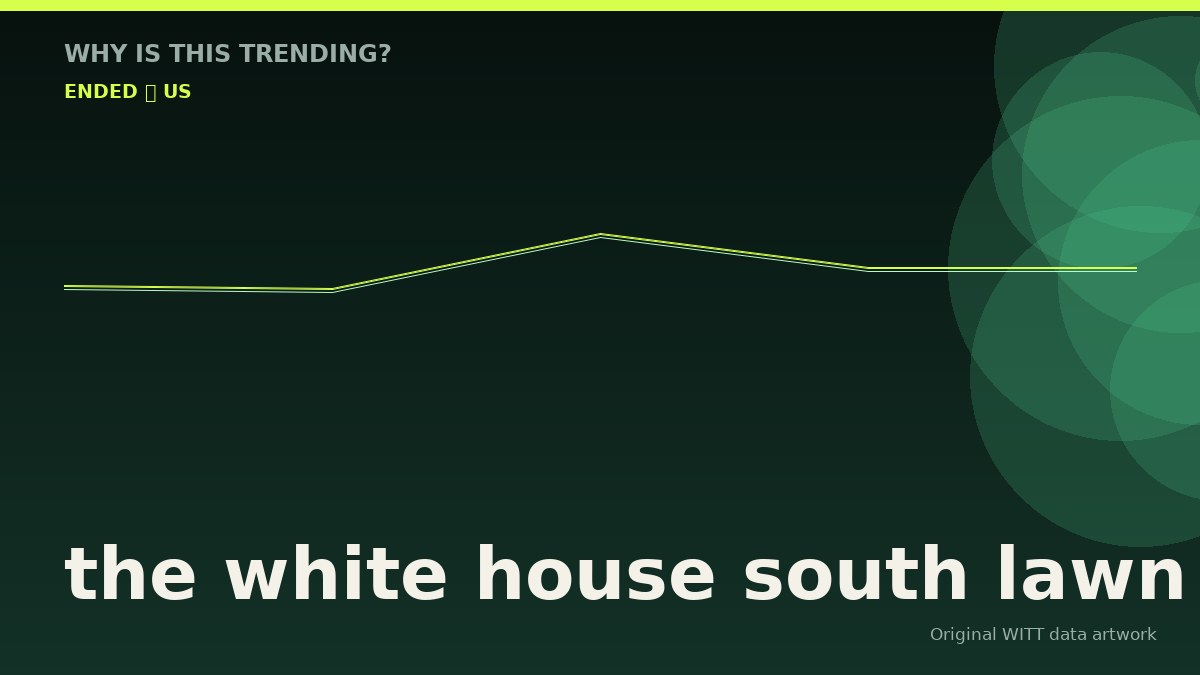
Decoding the National Mall Grass Spike
When digital attention shifts abruptly toward a familiar landmark, the movement is rarely driven by a single isolated variable. On August 17, 2026, web traffic and queries regarding the presidential grounds experienced a sharp upward trajectory. This surge coincided directly with the publication of news reports covering a social media statement issued by President Donald Trump via Truth Social (AP News). Rather than emerging from routine political news, the attention mechanism was triggered by a striking juxtaposition: an accusation of intentional vandalism aimed at a browned, patchy stretch of urban turf that had recently served as the epicenter for a major federal holiday production (Forbes).
Understanding this trend requires separating the raw attention metrics from the underlying factual record. Google Trends data reflects that users flocked to search engines to investigate the claims, but the public curiosity was largely sustained by the visible friction between the administration's narrative and documented physical evidence from the site (AP News). Observers and news consumers were left parsing how ordinary lawn wear from a massive summer event transformed into a point of political contention.
Tracing the Roots of the Turf Dispute
The core of the controversy centers on a specific grassy corridor connecting the World War II Memorial and the Lincoln Memorial Reflecting Pool on the National Mall (AP News). In his online post, the president shared an image of the discolored landscape, stating: Look what VANDALS did to the grass connecting the vandalized World War II Monument and the vandalized Reflecting Pool, which will be opened again, and better than ever, shortly
(AP News).
However, independent photo documentation tells a very different story about the origin of the brown patches. Streaming webcams and Associated Press photographs captured during early July revealed that this exact tract of land was smothered by heavy infrastructure—including a massive bandstand, staging equipment, and extensive seating arrangements—deployed for the country's Salute to America event honoring its 250th anniversary (AP News). Photos taken immediately after the celebration dismantled the structures showed the turf underneath already compressed, brown, and visibly damaged from the heavy crowds and staging weight (AP News).
Weighing Signal Against Noise in Vandalism Investigations
To evaluate what is real and what is political narrative, it is helpful to look at how federal authorities have handled actual vandalism incidents in the immediate vicinity. The president’s recent statements arrived on the heels of a genuine arrest involving the nearby World War II Memorial, where a suspect was taken into custody after spray-painting graffiti and introducing soapy bubbles into a monument fountain (AP News). That criminal case, handled by U.S. Attorney Jeanine Pirro's office, focuses strictly on explicit acts of defacement (AP News).
By contrast, previous administration claims regarding the Lincoln Memorial Reflecting Pool—where Trump insisted damage was caused by malicious actors rather than flawed renovation practices—were formally walked back by federal prosecutors who concluded the deterioration stemmed from rushed installation methods (The New Republic). The public fixation on the White House and National Mall parameters thrives precisely because the administration continues to blend verified criminal mischief with disputed explanations for ordinary wear and tear (Forbes).
“There may have been some contractor difficulty, but the major damage was caused by VANDALS!”
President Donald Trump
Ultimately, the surge in digital interest highlights a recurring pattern: when high-profile political figures point toward visible infrastructure decay and attribute it to malicious intent, the claims immediately pull in public scrutiny—even when photographic evidence and official findings point directly back to heavy crowds and temporary construction projects (AP News). Readers navigating these trending topics should distinguish between verified judicial actions, such as arrests for physical spray-painting, and unsubstantiated attributions regarding urban turf maintenance.