The Anatomy of a Traffic Spike
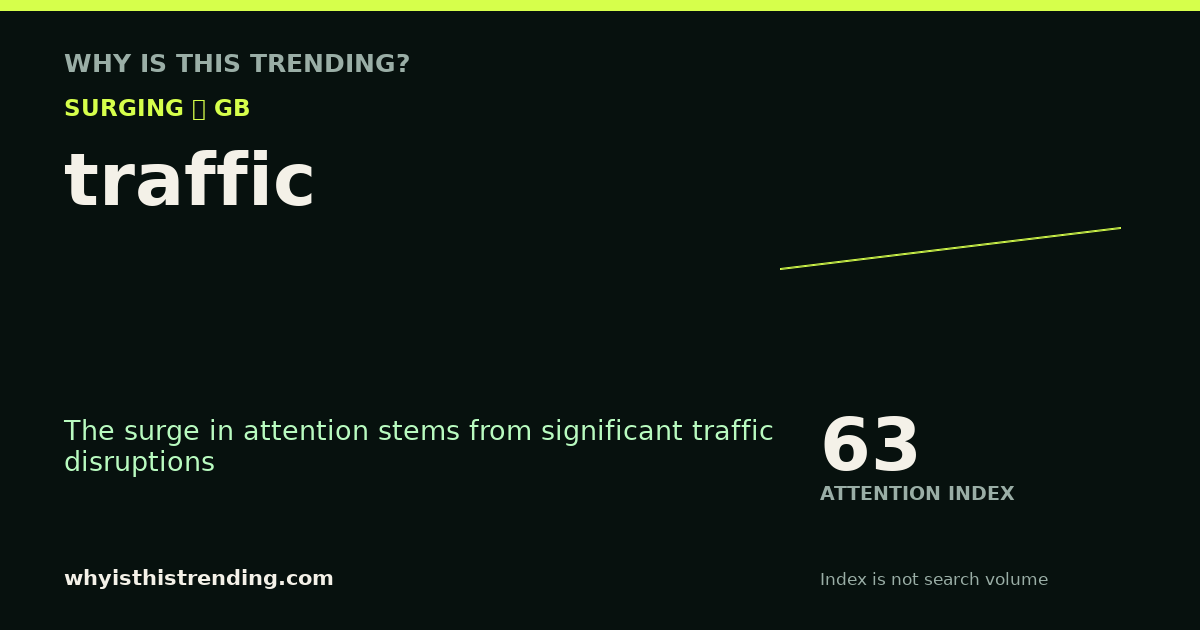
For motorists navigating the M5 in Somerset, the motorway has recently become a source of significant uncertainty. The current surge in public attention follows a series of distinct events that have highlighted the sensitivity of the region's road network during the peak summer holiday season.
On 24 July 2026, the M5 experienced heavy congestion following a collision on the southbound carriageway between junction 19 and junction 20. The incident resulted in the closure of two of the three lanes, leading to approximately four miles of traffic on the approach as reported by Bristol Live. This followed a separate, distinct event on 17 July 2026, when the motorway was closed between junction 23 and junction 24 due to a police-led incident documented by BBC News.
From Routine Delay to Public Safety Concern
The attention surrounding these delays is driven by both the logistical impact on travel times and rising anxiety regarding passenger safety. A report involving a mother whose infant overheated in a vehicle during the 17 July closure has become a focal point for public discourse. In that instance, with temperatures reaching 28C, the mother noted the difficulty of remaining stationary in a vehicle without shade, underscoring the risks inherent in prolonged motorway stoppages during hot weather.
The following table summarizes the factors contributing to the current traffic environment on the M5:
| Factor | Observed Impact |
|---|---|
| Seasonal Volume | High baseline congestion due to peak summer holiday travel. |
| Incident Types | Distinct events including police-led closures and vehicle collisions. |
| Public Sentiment | Increased concern over passenger safety during stationary delays. |
| Political Scrutiny | Formal requests for reviews of motorway incident management. |
Political and Operational Pressure
The frustration regarding these disruptions has reached local government. Ashley Fox, the MP for Bridgwater, has characterized the recent traffic issues as increasingly unacceptable for local communities
and has written to Local Transport Minister Simon Lightwood to urge an urgent review of how incidents are managed on the motorway. This political intervention highlights that the issue has transitioned from a logistical challenge to a matter of policy and public accountability.
Operationally, National Highways and Avon and Somerset Police face the challenge of balancing the need for thorough investigations at collision sites with the pressure to restore traffic flow. While authorities maintain that the safest place for motorists during a stoppage is inside their vehicle, this guidance is being tested by the realities of summer temperatures. Drivers are advised to check current traffic conditions and forecasts closer to their departure time, as motorway conditions can change rapidly.
Distinguishing Signal from Noise
It is important to distinguish this specific motorway trend from other concurrent automotive news. While reports of large-scale vehicle recalls—such as the recent National Highway Traffic Safety Administration notice regarding over 565,000 Ford Bronco and Bronco Raptor vehicles due to potential engine compartment fire risks—are appearing in the same news cycle, they are distinct from the M5 traffic situation. The M5 trend is a localized reaction to infrastructure strain, whereas the recall news is a broader industry-wide development. Similarly, while reports on air traffic controller shortages provide context for broader transport infrastructure concerns, they do not share a causal link with the ground-level gridlock in Somerset.
For those planning travel on the M5, the current environment remains volatile. National Highways has previously noted that high volumes of traffic are common across all days during the holiday period, straying from the traditional weekend-only peaks. With potential delays documented by National Highways—including forecasts of 34-minute delays southbound and 70-minute delays northbound during peak periods—proactive planning remains the primary tool for motorists, though it cannot eliminate the risk of sudden, unforeseen closures.