The Catalyst Behind the Resurgence
When public attention spikes sharply around an event that happened nearly two decades ago, it rarely occurs in a vacuum. The current wave of interest in Travis Barker’s 2008 plane crash is directly tied to the rollout of his feature-length documentary, Travis Barker: Louder Than Fear. Co-directed by Justin Krook and Michael Dwyer, the film arrived on Hulu and Disney+ following an initial debut earlier in the year at the Tribeca Festival as reported by Rolling Stone.
While the documentary spans a wide window of the Blink-182 drummer's life—covering his musical beginnings, recovery, and eventual return to flying—the marketing and press tour leaned heavily into the most harrowing chapter of his biography. The official trailer dropped on August 11, 2026, setting off a chain reaction across social media and entertainment news outlets as noted in Rolling Stone's coverage. Just days later, the film made its wide streaming debut on August 13, 2026, widening the audience for these intense historical reflections.
Unpacking the Premonition Narrative
What turned a standard documentary release into a viral talking point was a series of candid promotional interviews. Most notably, an appearance on Jay Shetty’s podcast brought forth detailed, chilling accounts of the hours leading up to the September 2008 flight in South Carolina as detailed by Page Six.
Barker recounted feeling an overwhelming sense of dread before boarding the small private jet, even calling his father to express deep unease and ask that his children be looked after if anything happened according to Page Six's interview breakdown. More striking to audiences was his recollection of his daughter, Alabama Barker—who was three or four years old at the time—crying uncontrollably and repeating that the roof’s gonna come off
as covered by Page Six.
In trend-forecasting terms, these retrospective narrative hooks act as powerful multipliers. They shift the public conversation from a historical tragedy into a psychological mystery, encouraging fans and casual viewers alike to re-examine the reported coincidences. When a public figure revisits a trauma with this level of granular detail, it invites viewers to experience the emotional gravity firsthand, bridging a nearly twenty-year gap.
Signal Versus Noise in the Current Discourse
When analyzing why a story captures collective attention, it helps to separate the active promotional engine from organic public fascination:
- Signal: The release of primary-source archival material, firsthand documentary interviews, and new biographical confessions regarding the long-term mental and physical aftermath of the crash, including Barker's struggles with painkiller addiction and survivor's guilt.
- Noise: Internet speculation attempting to treat retrospective storytelling as supernatural validation, rather than viewing it through the lens of trauma processing and post-hoc narrative framing.
The crash itself—which tragically claimed the lives of Barker's assistant Chris Baker, bodyguard Charles “Che” Still, and both pilots, leaving Barker and Adam “DJ AM” Goldstein as the sole survivors as documented by Page Six—remains a defining, somber milestone in modern music history. The documentary provides a platform for Barker to address his recovery, subsequent medical hurdles, and eventual healing noted by Rolling Stone, grounding the sensational elements of the premonition talk in a broader, highly personal journey of resilience.
Interpreting the Attention Mechanism
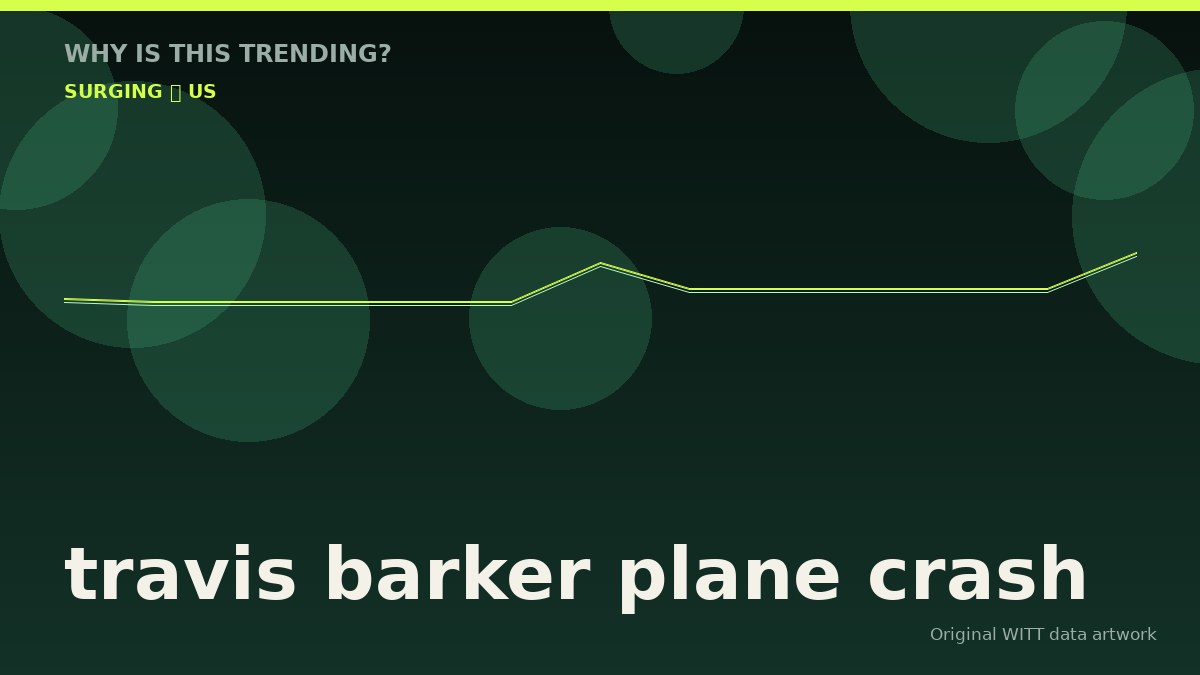
Google Trends attention spikes whenever legacy media properties package historical adversity into modern, high-definition streaming formats. It is important to note that search trends measure public curiosity and engagement, not direct proof of metaphysical phenomena or causal certainty. What we are witnessing is a classic case of promotional timing colliding with a deeply human fascination with near-death survival stories.
For readers and culture watchers, the takeaway is clear: promotional rollouts that leverage raw vulnerability will consistently outperform standard press cycles. By opening up about family premonitions, private grief, and recovery alongside wife Kourtney Kardashian and his children, Barker has transformed a harrowing historical footnote into an active cultural dialogue about trauma and survival.