Understanding the Enforcement Action
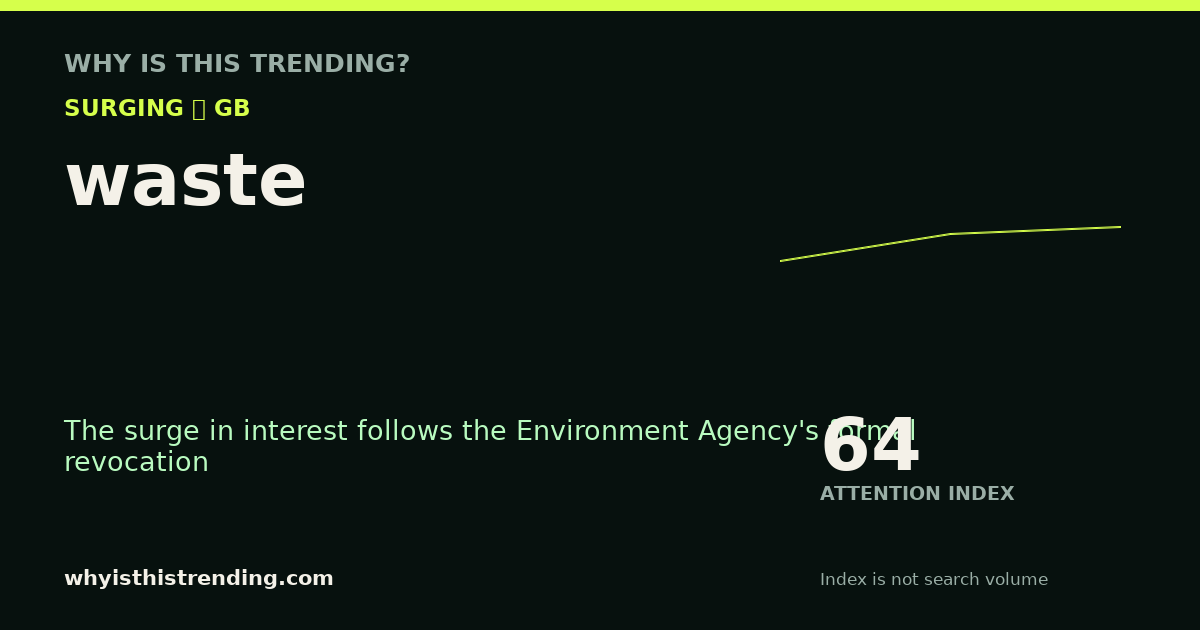
The recent spike in public attention regarding “waste” in the UK, specifically centered on the North West, is a direct response to the Environment Agency's (EA) decision to pull the plug on two specific waste management operations. On July 16, 2026, the regulator served formal revocation notices to EWS NW Ltd in Dukinfield, Greater Manchester, and BJL Waste Management Ltd in Glossop, Derbyshire.
For the affected communities, this is the culmination of a protracted regulatory process. The revocation is not a sudden, arbitrary move but the final step in a sequence of failed interventions. Both companies had previously been issued suspension notices—BJL in December 2025 due to concerns regarding contaminated run-off entering a local watercourse, and EWS in January 2026 following fire safety concerns. When these operators failed to complete the mandatory remedial actions, the EA moved to terminate their permits entirely.
The Timeline of Revocation
The regulatory process provides a specific window for these companies to appeal to the Planning Inspectorate. If no appeal is lodged, the permits cease to exist on the following schedule:
| Operator | Location | Revocation Date | Waste Removal Deadline |
|---|---|---|---|
| BJL Waste Management Ltd | Glossop, Derbyshire | 21 July 2026 | 18 August 2026 |
| EWS NW Ltd | Dukinfield, Greater Manchester | 3 August 2026 | 1 September 2026 |
It is important to note that if an appeal is submitted, the permits remain in force until that legal process is resolved. However, as of the current reporting, the operational status of these sites remains under strict scrutiny, and the failure to clear waste by the specified deadlines could lead to further criminal proceedings.
Signal vs. Noise: Why This Matters Now
In the context of broader digital trends, the term “waste” is often subject to high-volume noise. For instance, sports media frequently uses the term to describe underperforming athletic efforts, such as the recent coverage of the New York Yankees' pitching performance. Additionally, unrelated political protests in India have dominated search queries for terms that occasionally overlap with general news aggregators. However, the specific spike in search interest on July 23, 2026, is a clear signal of local concern regarding environmental enforcement.
This is not just about two specific sites; it is a visible test case for the Environment Agency’s 10 Point Plan, a strategy launched in March 2026 designed to accelerate intervention against persistent poor performers. Jeni Brittlebank, the Area Environment Manager, emphasized that the agency is moving toward a more “decisive” posture. The signal here is the shift in regulatory philosophy: the EA is signaling that it will no longer tolerate the “persistent poor operator performance” that has historically plagued the sector. By publicizing these revocations, the agency is effectively putting other operators on notice that the threshold for patience has been lowered.
Contextualizing the Regulatory Shift
The Environment Agency’s 10 Point Plan represents a pivot toward intelligence-led enforcement. By focusing on faster, more targeted action, the agency aims to prevent unlawful sites from becoming established in the first place. This strategy involves deeper integration with local authorities and police forces to disrupt organized waste crime. The revocation of the Dukinfield and Glossop permits serves as a practical demonstration of this policy in action, moving from passive monitoring to active site closure when remedial notices are ignored.
This shift is significant because it addresses a long-standing critique of environmental regulation: that enforcement is often too slow to prevent environmental damage. By highlighting these specific cases, the EA is attempting to build public trust and demonstrate that the “10 Point Plan” is more than just administrative rhetoric.
How to Engage Responsibly
The Environment Agency maintains that public vigilance is a critical component of its detection strategy. If you are concerned about the activities at a permitted waste site or suspect illegal dumping, the agency encourages direct reporting rather than relying on social media speculation. You can contact the Environment Agency at 0800 807060 or report anonymously through Crimestoppers at 0800 555111. These channels provide the necessary data for the agency to maintain its intelligence-led approach to enforcement. By using these official channels, residents ensure that their concerns are logged within the formal system, which is essential for the agency to justify further enforcement actions under its updated strategy.